Here’s my new blagsheet…. Your feedback always massively valued. https://web.thecrowhillcompany.com/blagsheets/BLAGSHEET_PEDALS_POSTER-v0.3.pdf
1 Like
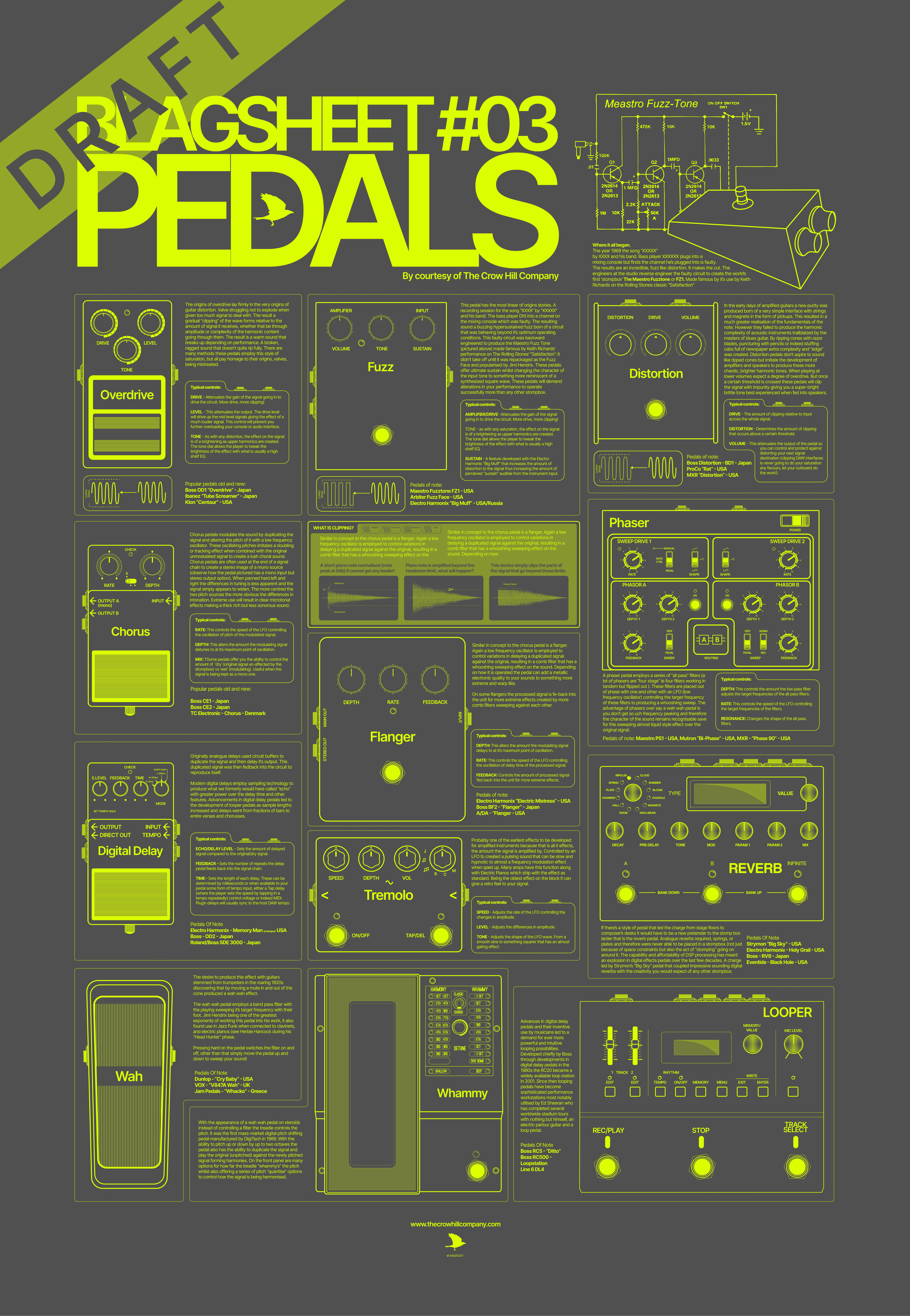
Hi Christian, will try and work my way through the whole sheet, but to get the ball rolling I noticed the Xs in the description of the Maestro Fuzz Tone at the top and thought maybe I could help there. Leaving aside the typo in the diagram title, I’d try a mu symbol for the capacitor values as these are micro farads, not to be confused with the M for mega used in the resistance values. On the Xs, my understanding is that session guitarist Grady Martin is using a Danelectro 6 string bass (so presumably a UB-2 given the date) on a recording session for Marty Robbins (I think the song was Don’t Worry) in 1961 when a faulty mixing desk pre-amp produced the fuzz sound. Later that year Martin went to the same studio and used the same channel on the desk to record a number called The Fuzz. Thereafter the pre-amp failed altogether so studio recording engineer Glenn Snoddy and electronic engineer Revis Hobbs took it apart and from their analysis of its failure created a circuit that would replicate the fuzz sound independent of the desk. This they sold to Gibson who put it on the market in 1962 as the Maestro Fuzz Tone (FZ-1). Not all fuzz effects from that era used the FZ-1, the Ventures had steel guitarist and electronics hobbyist Red Rhodes make them a box that produced a very similar effect, having heard Martin’s The Fuzz, that owed nothing to the original mixing desk pre-amp failure and many people just took razor blades to the Celestion ‘Blue’ speakers in Vox AC-30 and AC-50 guitar amps to get a fuzzy, distorted effect. Hope that’s useful as a start.
it may be worth noting that the latest RC series is comprised of 4 size pedals, the RC1 and 5 stomboxes, the RC10R that’s just a bigger stombox, the RC500 which would be the new version of something like the RC30 that’s 2 tracks with a bunch of cool stuff and the RC 600 being the largest with 6 tracks. - from all of these i believe the RC-1 and the RC-500 are the most popular
the ditto is from TC electronics and similar to the RC-1 but it reads on the sheet like the rc-5 is called ditto which is not the case, AND the ditto now has a whole range of options from single to 2 and 4 tracks
the line 6 DL4 TECHNICALLY is actually a delay pedal but i can see why it would go next to loopers, people use it although other delay pedals have this similar functionality
also i noticed you didnt mention compressors, preamps, amp sims, or bass pedals
yes pedals is a huge deal so i get it you cant cover them all! but bass players use a completely different range of pedals, maybe a second blagsheet? cause we use compressors, DIs, preamps, synths and octavers which might be worth mentioning, specially octavers and compressors!
I would second what @jordonez6 said about effects for bass. Compressors and octavers for sure, plus envelope filters (Musitronics Mutron, Electro-Harmonix Bassballs etc) and chorus pedals designed for bass with a type of low/by-pass filter that allowed the frequencies below the filter setting to pass unaffected. Chorus on the lower octave can just make the sound too muddy, so one shouldn’t use a chorus pedal meant for guitar on a bass…. unless you like muddy! It’s a different game down among the low frequencies! I think Chris Squire (Yes, Squackett) used a Behringer bass brassmaster that uses the Fuzz Tone circuit combined with an octaver, but then he also used an Eventide Harmonizer so he’s a real outlier when it comes to pedal boards.